Article on new Trump's DOE appointment Eric Wright and his positions on energy use.
https://sourcenm.com/2025/02/
Wednesday, February 26, 2025
U.S. Energy Secretary Wright tours New Mexico national labs

NRC Begins Special Inspection at Hope Creek Nuclear Power Plant
Nuclear Regulatory Commission - News Release
No: I-25-001 February 25, 2025
CONTACT: Diane Screnci, 610-337-5330
NRC Begins Special Inspection at Hope Creek Nuclear Power Plant
The Nuclear Regulatory Commission has launched a special inspection at the Hope Creek Nuclear Generating Station to review the circumstances of the repeated inoperability of one of the plant’s emergency diesel generators. The plant is operated by PSEG Nuclear, LLC.
Plant operators declared one of four emergency diesel generators inoperable on February 20 when water was detected in the lube oil system after the diesel was run following planned maintenance. A similar event occurred on January 31 and PSEG took steps to address the issue at that time.
The NRC determined a special inspection was warranted because this is a repeat issue. Emergency diesel generators are important because they provide backup power to safety equipment when power from the electrical grid is not available.
“While this did not affect safe plant operation, an independent review of the issue by the regulator is warranted given the repetitive inoperability of a safety-related system,” said Region I Administrator Andrea Kock. “Our inspectors will evaluate PSEG’s response, its work to find the cause, and actions the company is taking to ensure the equipment issues are corrected.”
Once the inspection is completed, NRC inspectors will document their findings in a publicly available inspection report, which will be distributed electronically to listserv subscribers and available on the NRC website.
The plant is in Hancocks Bridge, New Jersey.
"Constellation and Other Nuclear Stocks Live and Die on AI News Now. It Is a Problem."
Constellation and Other Nuclear Stocks Live and Die on AI News Now. It Is a Problem.
By Avi Salzman
Feb 24, 2025 1:52 pm EST
In this article
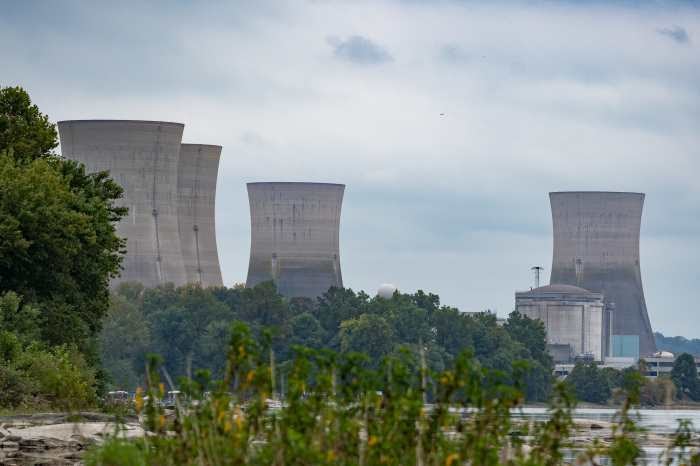
Nuclear energy stocks tumbled on Monday, continuing a downswing that started on Friday. The stocks’ fortunes are closely tied to growth in artificial intelligence, and there’s news that the demand for power from one big tech player may not be as high as expected.
Two reports from analysts at TD Securities released on Friday and Monday said Microsoft
-1.03% canceled some data center leases, amounting to a couple of hundred megawatts—or enough to power 150,000 or so homes. The report on Monday said that Microsoft’s spending is being supplanted by other players like Oracle
The mere hint that a big player is pulling back was enough to rattle the market. It’s similar to what happened to these stocks when Chinese AI company DeepSeek suggested that tech firms can make AI products that use less power.
Microsoft, in a statement to Barron’s, played down reports of a pullback, saying that while it sometimes makes spending adjustments, it’s still on track to spend over $80 billion this fiscal year on infrastructure “as we continue to grow at a record pace to meet customer demand.
“While we may strategically pace or adjust our infrastructure in some areas, we will continue to grow strongly in all regions,” a Microsoft representative said.
-5.88%, the country’s largest owner of nuclear plants, was down 6.9% in early afternoon trading. Vistra Corp. VST -5.11%, another large nuclear and natural gas plant owner, was down 3.6%.
Nuclear reactor developers Oklo and NuScale dropped 9% and 1.2% respectively, after previously being down much more.
Paul Dotson, equity trading managing director at TD Securities, wrote in an email that the market appeared to be overreacting to the news. (Dotson wasn’t involved in the reports.) The news “is being misinterpreted,” he wrote. One issue is that the stocks had risen a lot beforehand and investors are “viewing news from a negative perspective—especially from sectors and themes which have outperformed.”
The selloff could signal a larger long-term issue for the stocks.
Nuclear and AI have been a great match over the past year. The nuclear stocks have soared on expected demand from new AI data centers owned by large tech firms like Microsoft. The tech companies like nuclear power because the electricity the reactors produce is reliable and the reactors don’t emit carbon, allowing the companies to meet carbon emissions pledges.
But the nuclear-AI connection isn’t always a great thing for nuclear companies. Upstart nuclear companies like Oklo have to prove over a long time period that they can construct and operate plants at reasonable costs. But their overall value is jumping up and down based on rumors or whims about the intentions of tech companies. The fate of the stocks can fluctuate on an hour-to-hour basis based on news they have no control over.
Write to Avi Salzman at avi.salzman@barrons.com
"Federal Regulator’s Approval for Gas Plant Queue-Jumping Sparks Outrage"
Fossil Fuels
Federal Regulator’s Approval for Gas Plant Queue-Jumping Sparks Outrage
Critics argue the federal decision props up costly fossil fuels power plants, does little to ensure grid reliability and undercuts state clean energy goals.

By Aman Azhar
February 22, 2025
PJM Interconnection claims that these power projects are needed to help meet growing energy demand and keep the grid reliable. Credit: Joe Raedle/Getty Images
The Federal Energy Regulatory Commission’s approval of PJM Interconnection’s plan to let 50 power projects, including nuclear and gas-fired plants, cut the line and connect to the grid ahead of hundreds of stalled renewable energy projects has ignited fierce backlash, with critics calling it “a dangerous precedent” that props up costly fossil fuels and tips the scale against renewables. The decision does little to fix PJM’s broken interconnection process, they argue, and deepens the rift between PJM’s reliability strategy and state-led clean energy goals.
PJM’s Reliability Resource Initiative (RRI) aims to fast-track new nuclear and fossil fuel generation projects to offset anticipated energy shortages as early as 2026, as coal plants retire and demand from data centers and increased electrification spikes.
Dispatchable power, like natural gas, is essential to reliability, partly due to state policies phasing out coal, PJM, the grid operator for the District of Columbia and portions of 13 states across the mid-Atlantic, South and Midwest, has argued.
But clean energy leaders insist renewables and battery storage could address reliability just as effectively if given a fair shot. They say PJM rules favor capital-intensive fossil fuel plants that are slower to build and complicate states’ clean energy goals.
FERC approved PJM’s proposal by a 3-1 vote on Feb. 11, with Commissioner Judy Chang dissenting and Commissioner Lindsay See abstaining.
In its decision, FERC agreed with PJM’s rationale that a one-time arrangement was needed to prevent potential electricity shortages by 2030, and that allowing 50 large power projects to move ahead will help meet growing energy demand and keep the grid reliable. FERC also endorsed PJM’s method of choosing these projects based on their impact and readiness, ensuring that the most needed and reliable projects get priority, especially in areas facing power supply challenges.
Not everyone agreed, though.
In her dissent, Chang slammed PJM’s scoring system for prioritizing size over speed, warning it won’t bring new power online fast enough to meet reliability risks predicted to occur between 2026 and 2030. “PJM’s filing presents a risk of the worst of both worlds: it compromises the Commission’s open access principles with no guarantee it will resolve PJM’s reliability issue,” she wrote. She said PJM ignored faster, grid-ready renewable projects in favor of larger, more complex plants that face permitting delays, supply shortages and transmission bottlenecks.
Chang also criticized PJM for capping approvals at 50 projects without ensuring enough capacity would be available to meet demand. She argued PJM overemphasized project size while failing to prioritize projects that use existing grid infrastructure, which could be deployed faster and at lower cost. “PJM, when designing its proposal, should have ensured that the in-service dates of the interconnecting resources receive the greatest weight,” she said.
In emailed comments, PJM spokesperson Jeffrey Shields said: “PJM continues to process new renewable projects and still they are not getting built fast enough to replace retiring generators while meeting growing demand.” He expressed his frustration at being called out for not processing enough renewable projects, claiming that PJM was “successfully implementing the reformed process and moving tens of thousands of megawatts worth of projects to completion in our study process.” Shields said that FERC’s order adequately explained the reasons why a measure like the RRI was necessary.
Still, Chang’s criticism was echoed by clean energy advocates.
Tom Rutigliano, a senior advocate with the Natural Resources Defense Council, called FERC’s decision “a dangerous precedent” that expands emergency measures far beyond their intended scope.
“RRI is PJM admitting their interconnection queue is too slow to solve problems even with six years’ notice. That’s what PJM should be working on,” he said. If PJM had a speedy, efficient queue, “we could rely on markets and competition to solve this problem, rather than picking winners and losers.” He warned the decision creates market uncertainty because developers won’t know until years later when their projects will come online and if they must compete with RRI-backed projects.
Like Chang, Rutigliano argued that PJM’s rules favor fossil fuels and dispatchable resources over renewables and battery storage.
“There are two real problems with the criteria,” he said. “First, project size is considered more important than completion date, so RRI is likely to select large projects that won’t be completed far after the reliability problem PJM claims they’re trying to fix. Second, the scoring criteria exaggerates the difference between thermal resources and storage. It makes sense for PJM to consider the reliability value of the resources they pick, but that should be done fairly.”
Ada Statler, an associate attorney with the advocacy organization Earthjustice, said “the calculations PJM uses to justify the Resources Reliability Initiative fail to consider other sources of new generation that could close the gap without harming resources that have already been waiting to interconnect for years or frustrating state climate policy.” She cited a study from the sustainability nonprofit RMI that said PJM already has 3 gigawatts more power than needed if renewable projects and grid reforms moved forward.
“PJM is giving itself too much control over decisions about the generation mix that are supposed to be left to the states.”
— Ada Statler, Earthjustice
Statler also questioned PJM’s accounting of projects. ”While load growth is certainly accelerating, PJM has yet to develop an effective method of verifying that load growth projects are not speculative or double-counted from duplicative requests submitted in multiple areas,” she said.
Megan Wachspress, an attorney with the Sierra Club, warned that PJM is overstepping its authority by choosing which power plants get special treatment. “These criteria are not neutral or within the proper authority of the regional grid operator, meaning they interfere with state control. Even worse, this approach goes against state policies in New Jersey, Michigan and Illinois, which aim to boost renewable energy on the grid.”
Consumer advocates argue PJM’s lack of transparency is raising electricity prices across its service area. The Maryland Office of People’s Counsel has warned PJM that utilities and power suppliers may be exaggerating demand forecasts, leading PJM to uncritically accept speculative growth projections.
“We are concerned that because the RRI plays favorites by choosing which resources get special treatment in the interconnection process, PJM is giving itself too much control over decisions about the generation mix that are supposed to be left to the states,” Earthjustice’s Statler said.
Rutigliano agreed. “If states can’t get power plants connected, their authority is meaningless,” he said. “The law says that states have authority over generation, while the federal government controls transmission. That’s always been a balancing act, but the RRI ruling pushes far enough that the state’s authority becomes meaningless.”
Instead of focusing on short-term fixes, advocates urged FERC to follow rules it has already implemented, such as Order 2023. The rule is designed to speed up and simplify the process for connecting new power projects to the grid, reduce long wait times, improve transparency and help renewable energy projects get online faster by reforming how grid operators handle interconnection requests. It requires utilities to process projects in groups rather than one by one, making the system more efficient and reducing delays.
“Commissioners [David] Rosner and [Willie] Phillips supported RRI only as a one-time emergency measure. PJM must comply with Order 2023 and speed up interconnections to fix delays that block renewables from replacing outdated coal plants,” said Wachspress of the Sierra Club. “Instead of delays, PJM should focus on long-term transmission planning, expansion, and reducing interconnection wait times.”
Jacob Mays, an assistant professor in the School of Civil and Environmental Engineering at Cornell University, said he expects to see more ad hoc modifications like RRI in systems across the U.S. given ongoing struggles with the queue process. “I think it is widely thought that more fundamental reforms enabling greater predictability and stability would be best in the long term,” he said, “but system operators are very focused on what they can do to address near-term concerns.”
Sunday, February 23, 2025
Trump's attack on Biden's IRA spending raises could complicate Palisades restart effort | The Blade
https://www.toledoblade.com/
Trump's attack on Biden's IRA spending raises could complicate Palisades restart effort
TOM HENRY
The Blade
Jan 23, 2025
President Trump’s freeze on Biden-era Inflation Reduction Act spending has, if nothing else, caused some confusion about the future of the historic Palisades nuclear plant restart effort and its ability to remain on the schedule outlined by its owner, Holtec International.
The cornerstone of the unprecedented project is a $1.52 billion loan agreement the U.S. Department of Energy finalized in September with Holtec.
The DOE money for that loan is coming from the Biden-era Inflation Reduction Act, distributions from which Trump has frozen through an executive order. He also has ordered unspent money to be returned.
The IRA has been called America’s largest single investment in fighting climate change. Trump opposes it because, as a matter of policy, he doesn’t want to spend money on climate change projects.
“I definitely think it's causing confusion, without knowing exactly how the deal is structured,” said Edwin Lyman, director of Nuclear Power Safety for the Cambridge, Mass.-based Union of Concerned Scientists. “I think it depends on the project. At the minimum, it's confusing.”
For now, oil and natural gas drilling “will be king” under Trump, Mr. Lyman said.
The Nuclear Energy Institute, the nuclear industry’s chief lobbyist group on Capitol Hill, has in recent years rebranded the nuclear industry as a leading strategy for reducing climate-altering carbon dioxide emissions.
“The nuclear industry has been very successful in converting Democrats,” Mr. Lyman said. “That could backfire.”
But Nick Culp, Holtec Palisades senior manager of government affairs and communications, told The Blade he’s confident the project will remain on schedule and the DOE loan will be unharmed because of Trump’s general support of nuclear power as an energy source.
“We're very confident, based on the very strong support we're hearing from the President and his nominees,” Mr. Culp said. “We feel very confident the support will be there and there will be a place in which Palisades fits with America's energy agenda.”
Holtec, which has never operated a nuclear plant, is trying to make Palisades the first nuclear plant in American history to go back online after it has been mothballed and put into its decommissioning phase.
The plant ceased operations in May of 2022 when its previous owner, Entergy, said it was doing so permanently for economic reasons.
Michigan Gov. Gretchen Whitmer has been a strong supporter of the potential restart, calling the project an important part of her MI Healthy Climate Plan, which sets deadlines for the state to reduce its carbon emissions.
“We are reviewing. Thank you,” was the only statement received by The Blade from Ms. Whitmer’s office when asked for a comment about Trump’s executive order.
An online request for comment was submitted to White House communications, which acknowledged receipt but gave no immediate response.
“It’s certainly going to be disruptive,” Alan Blind, a retired nuclear power executive who once spent nearly seven years as the Palisades engineering director, said of Trump’s executive order.
While it’s possible the contract in place with the DOE will hold, even if all $1.52 billion hasn’t been distributed yet, that wouldn’t necessarily be the case if Holtec is found to be in violation of it.
He said there are multiple issues, one of the largest being the condition of the Palisades steam generator tubes.
The U.S. Nuclear Regulatory Commission verified at a recent meeting that steam generator tubes went two years before they were laid up in a wet chemical process that was supposed to be done immediately after shutdown if the goal was to preserve them for additional usage. That protocol is an industry standard supported by California-based EPRI, a consulting group the nuclear industry often relies upon.
Mr. Culp said the extent of damage of steam generator tubes was simply part of the inspection process. He did not respond when asked why it took so long to store them in the wet chemical process.
Kevin Kamps, an activist with Maryland-based Beyond Nuclear who grew up near the plant, said that safety assurances are “very dubious, as [the] NRC is completely captured by the industry it is supposed to regulate.”
The NRC has said multiple times, including recently, that it will not authorize restart unless it is convinced it is safe to do so.
The government regulator also reminded Holtec and its contractors during a public meeting at the NRCs national headquarters in Rockville, Md., last week that it is not beholden to the company’s timetable.
Mr. Culp told The Blade that Holtec is still eyeing restart for the fourth quarter of this year, despite issues raised by Trump’s executive order.
First Published January 23, 2025, 10:30 a.m.
Tom Henry
Follow to receive notifications any time Tom Henry publishes a new story
59 Followers
Join the Conversation
We value your comments and civil discourse. Click here to review our Commenting Guidelines.
Friday, February 21, 2025
TMI-1: NRC INSPECTION REPORT NOS. 05000289/2024001 AND 05000289/2024002
Dear TMI-1 Trackers,
Please see attached. Referenced in that document the December 19, 2024 SG Tube Inspection Report which I have
| Document Title: | Three Mile Island Nuclear Station, Unit 1, Steam Generator Inspection Report for End of Cycle 22 |
| Document Type: | Inservice/Preservice Inspection and Test Report Letter |
| Document Date: | 12/19/2024 |
Reminder of 10:00 am Conference Call Thursday on TMI-1 Restart
(605) 475-5900 Passcode 499877#
(605) 475-5900 Passcode 499877#
From: NRC Region I Correspondence <NRCRegionICorrespondence.
(Attached) Date: 02/19/2025 4:12 PM EST
Subject: CONSTELLATION ENERGY GENERATION, LLC, THREE MILE ISLAND NUCLEAR STATION, UNIT 1 - NRC INSPECTION REPORT NOS. 05000289/2024001 AND 05000289/2024002
CONSTELLATION ENERGY GENERATION, LLC, THREE MILE ISLAND NUCLEAR STATION, UNIT 1 - NRC INSPECTION REPORT NOS. 05000289/2024001 AND 05000289/2024002
ADAMS ACCESSION No. ML25044A127
Subscribe to:
Posts (Atom)
