SUN DAY CAMPAIGN
(founded 1992)
8606 Greenwood Avenue, Suite #2; Takoma Park, MD 20912-6656
follow on BlueSky at: @sun-day-campaign.bsky.social
April 20–May 3, 2026
To: Recipients
From: Ken Bossong, editor
Re. News Story Excerpts (New Studies & Data on Sustainable Energy & Climate Change)
Note: News story excerpts provided below do not necessarily reflect the views of the SUN DAY Campaign or any of its respective members.
# # # # # # # # # # # # # # # # # # # # # # # # # # #
WEEKLY NEWS STORY EXCERPTS
NEW STUDIES, DATA, AND RESOURCES:
Mixed/Multi-Sector:
Renewables Overtake Coal for the First Time as World’s Largest Electricity Source in 2025:
MSN.com, by Everett Sloane, April 22, 2026 and
and
For the first time on record, the world added enough renewable electricity in 2025 to outrun total growth in power demand, pushing fossil fuel generation into outright decline. The milestone was documented in Ember’s “Global Electricity Review 2026”. The result: global fossil fuel generation fell by roughly 0.2% year over year, and coal’s share of the worldwide electricity mix slipped below one-third for the first time. In the U.S., the pattern played out on a smaller but still visible scale. The Energy Information Administration’s monthly generation data shows solar output climbing steadily through 2025 while coal-fired generation continued its long slide.
======================================
Survey Says Support for Wind and Solar Energy Slips:
The Hill, by Ryan Mancini, April 22, 2026
https://thehill.com/policy/energy-environment/5843987-poll-shows-slip-in-wind-solar
A new Gallup poll shows that support for wind and solar energy has slipped, with a majority still favoring those energy alternatives. The poll found that 66 percent of Americans prefer the U.S. to put more emphasis on solar energy and 55 percent prefer the same with wind energy. Both dropped from Gallup’s previous polling on the question in 2021, when 73 percent preferred emphasis on solar and 66 percent preferred emphasis on wind.
====================================
Clean Power Grew U.S. Economy by $150 Billion and Supported 1.4 Million Jobs in 2025:
American Clean Power Association, April 28, 2026
and
According to the latest “Annual Clean Power Market Report” from the American Clean Power Association, the clean power sector invested $79 billion in new projects, supported more than 1.4 million jobs, and accounted for over 90% of all new electricity capacity added to the grid in 2025. Highlights from the report include:
**New Capacity Added: 50.3 GW (91% of all new grid additions)
**Total Economic Contribution: $150 Billion
**Direct Employment: 437,000+ Americans
**Industry Average Wage: $78,000 (15% above national average)
**Landowner Payments: $3.2 Billion in lease income
**State and Local Tax Revenue: $3 Billion
**Political Distribution: 79% of capacity located in Republican districts
**Total Operational Fleet: 363 GW (Enough to power 79 million homes)
====================================
New Report Highlights Clean Energy Investment Trends Amid Policy Uncertainty:
American Council on Renewable Energy, April 28, 2026
and
and
According to the report, “Clean Energy Investment Trends,” prepared for ACORE by S&P Global Energy’s consulting arm CERA Consulting, the clean energy market surged at the end of 2025, and investment in clean energy projects is likely to reach a record high in 2026. M&A surged in 2025—especially in natural gas-fired generation—as AI raced to secure power sources. Q1 2025 M&A exceeded total M&A activity in 2024. Investment in renewable projects in 2026 could surpass 2025 investment as developers race to meet demand growth and claim expiring wind and solar tax credits.
====================================
U.S. Renewable Energy to Attract $120 Billion in Investment This Year:
Latitude Media, by Catherine Boudreau, April 28, 2026
According to a pair of industry reports from ACORE and the American Clean Power Association, the U.S. renewable energy sector is expected to attract $120 billion in investment this year and could install a record amount of new capacity - up to 62-GW - as developers race to meet demand growth and claim expiring tax credits for solar and wind projects. However, Trump’s permit delays and looming restrictions on China-linked components risk chilling investments. Policy uncertainty - combined with grid interconnection constraints and increasing competition from gas - could also adversely affect some investor interest. By 2028, gas is forecast to surpass onshore wind in newly installed capacity, but continue trailing solar and storage additions through the end of the decade.
===================================
Solar:
Solar as Well as EVs Soared Globally but Oil Fell in 2025:
ReNews.Biz, April 20, 2026
and
and
and
and
According to the International Energy Agency, global energy demand growth slowed in 2025. It reached 1.3% while solar PV became the largest contributor to global energy supply growth for the first time. Electricity demand increased by around 3%, more than twice the rate of overall energy demand growth. Solar PV generation increased by 600 terawatt-hours in 2025, marking the largest structural rise ever recorded for any electricity generation technology in a single year.
Solar PV accounted for more than 25% of the increase in global energy supply, followed by natural gas at 17%. Meanwhile, battery storage was the fastest-growing power sector technology, with around 110-GW of new capacity added during the year. Electric car sales increased by over 20% to more than 20 million units, representing around one in four new car sales worldwide. However, global energy-related CO2 emissions rose by around 0.4% in 2025.
===================================
Coal Mines, Landfills, and the Persistence of Solar Power:
The coal-to-solar transition has begun to emerge in the U.S., and the action is beginning to pick up as investors catch on to the land use opportunities presented by placing solar power plants on derelict surface mines as well as landfills and other industrial sites. In fact, the U.S. is sitting on a solar power gold mine of derelict surface mines. In a report last summer, the nonprofit organization Global Energy Monitor applied its coal mine tracking tool to identify 312 surface coal mines around the world that have been at or near the end of their useful lives since 2020. According to GEM’s calculations, those mines could host 103-GW of solar capacity, about enough to power a country like Germany for one year. GEM also spotted additional mining lands that are likely to be idled within the next five years, totaling another 185-GW.
===================================
Commercial Real Estate Companies Have Installed Over 1-GW of Solar Across the U.S.:
Solar Power World, by Kelly Pickerel, April 28, 2026
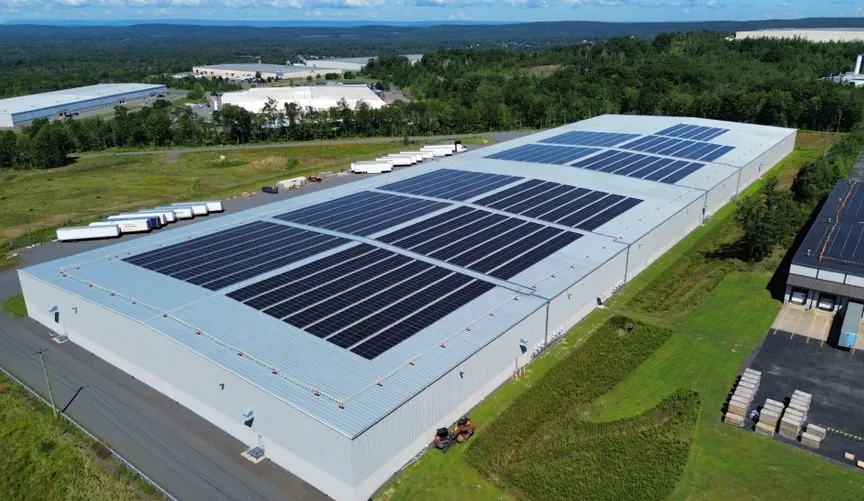
According to data compiled by solar buyer Black Bear Energy, the U.S. real estate industry has crossed 1-GW of installed on-site solar capacity. The 2025 Real Estate Solar Leaderboards shows that 1.086-GW has been installed across 2,157 projects from over 65 owners and managers. By the end of 2025, Prologis maintained its status as the industrial solar leader with a commanding 310.9-MW portfolio. Meanwhile, Public Storage emerged as the standout story in the 2025 report, claiming the No. 2 spot with 111-MW. Energizing 97.5-MW of solar within the last three years, the company has deployed 1,120 projects through a mix of self-funded initiatives and third-party owned leases for community solar markets, showcasing its commitment to rolling out solar at scale to generate new portfolio value.
===================================
Wind:
Global Wind Installations Hit Record in 2025:
ReNews.Biz, April 20, 2026
According to the Global Wind Energy Council’s “Global Wind Report 2026,” global wind installations reached a record 165-GW in 2025. Further, cumulative global wind capacity surpassed 1,299-GW, cementing wind as a cornerstone of modern energy systems. The council added that annual installations must double by 2030 to align with a net zero pathway and global climate targets.
========================================
U.S. Wind Capacity Additions Forecast to Reach 48-GW by 2030:
Review Energy, April 21, 2026
and
and
and
According to the “U.S. Wind Energy Monitor” report released by Wood Mackenzie, the U.S. wind sector is set to continue its recovery trajectory, with installations forecast to rise to around 11-GW in 2026 from 8.2-GW in 2025. The rebound follows a 49% year-on-year increase in 2025 and positions 2026 as the strongest installation year in five years. A key driver of near-term growth is a 15.4 GW pipeline of projects that have already cleared major commercial hurdles, pointing to incoming growth despite federal opposition, soaring costs, and permitting challenges. Land-based wind is expected to dominate U.S. additions in the next three years, accounting for around 24 GW between 2026 and 2028 (mostly onshore wind). Approximately 64% of this pipeline is already in advanced stages, including projects under construction, which reduces execution risk and improves certainty around delivery timelines. The West leads this year at 64% of connections, driven largely by Pattern Energy’s 3.5-GW SunZia project in NM. The Midwest is set to peak next year, and Texas may claim the top spot in 2028 with around 2.5 GW. Looking further ahead, Wood Mackenzie forecasts 48-GW of new wind capacity additions through 2030, supported by a sizeable pipeline of projects and improving execution visibility across both onshore and offshore segments.
=========================================
The World Is Embracing Offshore Wind - Even as the U.S. Retreats:
Canary Media, by Maria Gallucci, April 21, 2026
Offshore wind development has all but screeched to a halt in the U.S. amid the Trump administration’s unrelenting attacks. But in the rest of the world, it’s another story. Over 9-GW of new offshore wind projects came online last year, up 16% from the previous year’s installations, bringing the world’s total offshore wind capacity to about 92-GW, the Global Wind Energy Council said in its latest annual report. The sector is set to grow even more as nations in Europe and Asia seek out domestic clean power. Between 2027 and 2030, countries other than China are expected to add an average of 11-GW in offshore wind installations every year - almost triple the levels from 2022 to 2024, according to the research firm BloombergNEF. China alone could add the same amount over that three-year period.
=========================================
Bioenergy:
Total U.S. Output of Biofuels Remains Unchanged in January:
U.S. Energy Information Administration, April 27, 2026
and
and
and
The total volume of biofuels produced by the U.S. in January 2026 remained unchanged from the level produced in January 2025, although there were some fluctuations among the competing forms of biofuels. Fuel ethanol’s output rose slightly (up 0.84%) while production of biodiesel increased by 20%. Meanwhile, renewable diesel production fell by 10.34%. The mix of “other” biofuels (e.g., sustainable aviation fuel) remained unchanged. Taken together, fuel ethanol accounted for the largest share (73.17%), followed by renewable diesel (15.85%), biodiesel (7.32%), and “other” biofuels (3/66%).
==========================================
Densified Biomass Fuel Sales at 970,000 Tons in November:
Biomass Magazine, by Erin Krueger, April 27, 2026
According to the U.S. Energy Information Administration’s “Monthly Densified Biomass Fuels Report.” U.S. manufacturers produced approximately 900,000 tons of densified biomass fuel in November. Sales of densified biomass fuel reached 970,000 tons during the month. Domestic sales of densified biomass fuel reached 169,016 tons at an average price of $239.40 per ton. Exports reached 798,240 tons at an average price of $203.33 per ton.
========================================
Storage:
Lots of Storage Applies for Grid Connection Under PJM's New Process:
Renewables Now, by Ivan Shumkov, April 29, 2026
and
and
and
U.S. regional transmission organization PJM Interconnection has received grid-connection applications for 811 new generation projects with a combined capacity of 220 GW, including 66.5-GW of storage and close to 30-GW of renewables. Beyond storage, projects entering the interconnection queue include 106-GW of gas-fired generation, 18-GW of nuclear, 15-GW of solar, 9-GW solar-storage hybrid and 5-GW of wind. Under its new interconnection study process, PJM expects to complete its reviews of the projects in one to two years, depending on the project.
===================================
Electric Vehicles:
Used Electric Car Sales Hit a Record High in March:
Inside EVs, by Tim Levin, April 20, 2026
Used EV sales are bouncing back strongly after the end of EV tax credits in September.
In March, according to Cox Automotive, Americans bought 42,924 secondhand electric cars. That is by far the best month for used EVs since Congress eliminated all EV tax credits at the end of the third quarter of 2025. From October through February, monthly used EV sales numbered roughly 30,000, plus or minus a couple-thousand units, according to Cox. But that's not all. Last month's used EV sales represented a new record, surpassing August's 40,960 units. That previous record came at the height of the tax-credit-fueled EV-buying frenzy, so topping it this quickly is impressive.