The EFMR Monitoring Group is a non-profit, non-partisan organization which monitors radiation levels surrounding Peach Bottom Atomic Power Station, Susquehanna Steam Electric Station and Three Mile Island Nuclear Station.
France: National Assembly rejects »nonsensical« plan to halt expansion of solar and wind energy
On Tuesday, the French National Assembly rejected a proposal to stop expanding renewable energy sources. The corresponding bill was rejected by a vote of 377 to 142, with 47 members abstaining. Surprisingly, on Thursday, the National Assembly passed a moratorium on the construction of new solar and wind farms as part of an amendment to the energy bill with the support of Les Républicains (LR) and the right-wing populists of Rassemblement National (RN). The moratorium was to remain in force »until an objective, independent study ... ... more
GridParity launches new AgriPV initiative – economically viable even without solar package bonus
With a completely revamped product line and a clear strategic realignment, GridParity is launching a new AgriPV initiative that is economically viable even without the controversial bonus scheme included in the solar package. In view of the political uncertainties surrounding Solar Package II, GridParity is focusing on independence, transparency, and cost-efficient system solutions – with success: AgriPV systems close to farms are economically viable starting at just €350,000 per megawatt peak (MWp).
Solar package or not – GridParity lowers barriers to entry
“We wanted to create a system that doesn't depend on political favors,” explains project manager Eva Muhle. “Our customers need planning security and functioning business models – now, not sometime in the future.”
The revised pricing structure allows electricity production costs of just 3 to 4 cents per kWh, even with full feed-in to the grid. This means that investments can be solidly financed even below the regular EEG remuneration of 6.89 cents/kWh – without any additional bonuses.
Eight system variants – optimized for agriculture:
Denmark: Logistics company commissions 35 MW rooftop system
The new logistics center of the Danish logistics company DSV is home to what is currently probably the world's largest PV rooftop system. This was announced by Ernst Schweizer AG, which supplied the mounting system for it. The ballasted mounting system, »MSP-FR east-west,« was used. It is an aerodynamically optimized solution that does not require roof penetration.
The Danish contractor SolarFuture ApS installed a total of 78,000 solar modules on an area of over 300,000 square meters. The plant in ... ... more
German battery market to decline significantly in 2024
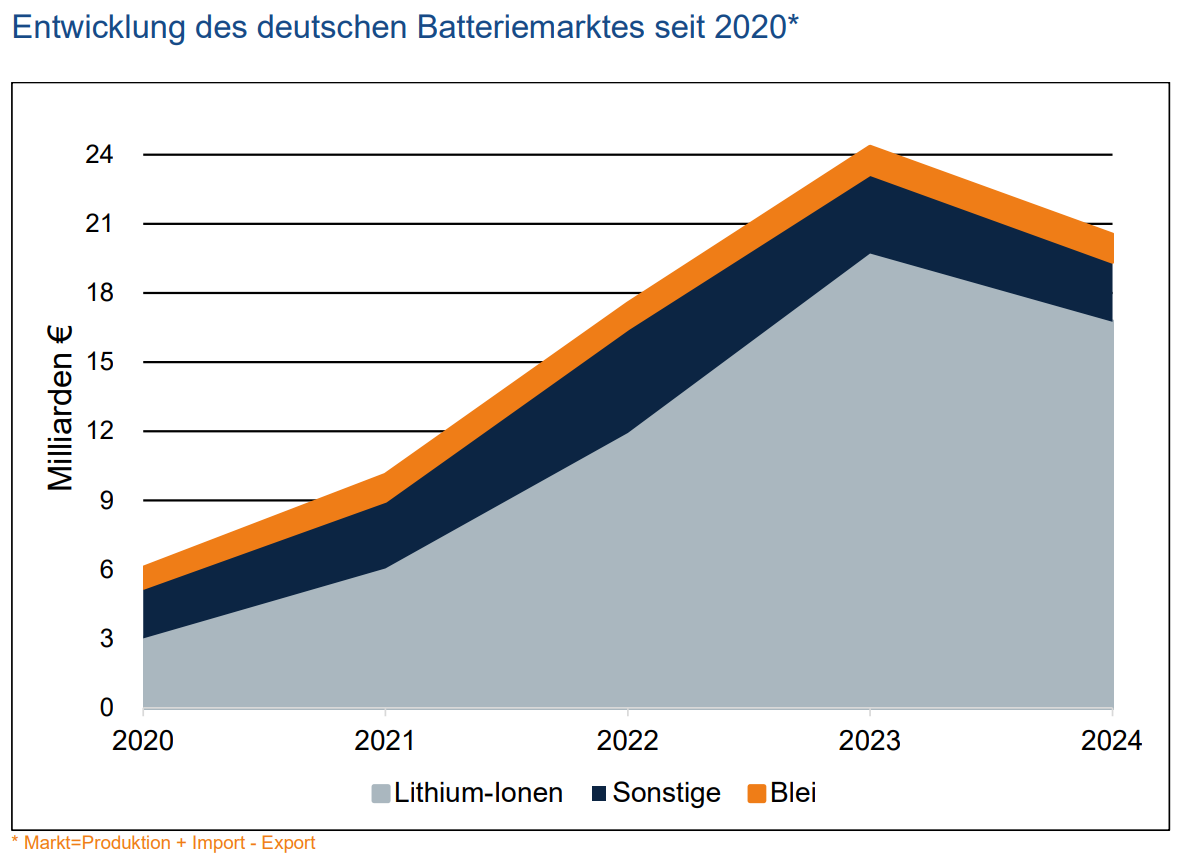
The German battery market reached a volume of €20.5 billion in 2024, according to the German Electrical and Electronic Manufacturers' Association (ZVEI). However, with a decline of €3.8 billion (minus 16 percent) compared to 2023, it was unable to continue the strong growth of the previous five years. The decline is almost entirely attributable to lithium batteries, which recorded losses of just under €3 billion. According to ZVEI, this is due to the recent weak development of electromobility in Germany, which is attributable, among other things, to ... ... more
Trianel GmbH, based in Aachen, is planning a large-scale battery storage facility on the outskirts of the Ruhr region in Waltrop, North Rhine-Westphalia. The first phase of expansion will achieve an output of 900 megawatts (MW) and a storage capacity of 1,800 megawatt hours (MWh). This has been announced by the company. The project will be built on a plot of unused land originally intended as a construction site for the neighboring Trianel coal-fired power plant in Lünen.
Trianel is implementing the project in cooperation with BKW AG, an ... ... more
NRC Reduces Hourly Rate for Advanced Nuclear Reactor Applicants and Pre-Applicants
The Nuclear Regulatory Commission has amended its regulations for the licensing, inspection, special projects, and annual fees it will charge applicants and licensees for fiscal year 2025. The fiscal year 2025 final fee rule was published today in the Federal Register.
In this rule, the NRC is making amendments to implement a reduced hourly rate for advanced nuclear reactor applicants and pre-applicants for certain activities as required by the ADVANCE Act of 2024. The reduced hourly rate is $148 per hour and represents an over 50% reduction from the full-cost professional hourly rate of $318 per hour. The reduced hourly rate will take effect on Oct. 1, 2025, consistent with the statutory effective date.
The FY 2025 final fee rule reflects a total budget authority of $944.1 million, the same as FY 2024. Under the Nuclear Energy Innovation and Modernization Act, the NRC is required to recover, to the maximum extent practicable, approximately 100% of the NRC’s total budget authority for FY 2025, less the budget authority for excluded activities. A proposed fee rule was published for public comment on Feb. 19, 2025.
After accounting for the exclusions from the fee-recovery requirement and net billing adjustments, the NRC must recover approximately $808.8 million in fees in FY 2025. The NRC assesses two types of fees: service fees, established in 10 CFR part 170, recovering the NRC’s costs of providing specific benefits to identifiable recipients (such as licensing work, inspections, and special projects); and annual fees, established in 10 CFR part 171, recovering generic and other regulatory costs not otherwise recovered. For FY 2025, approximately $205.4 million will be recovered through service fees under 10 CFR Part 170 and $603.4 million will be recovered through annual fees under 10 CFR Part 171.
Compared to FY 2024, annual fees are decreasing for the operating power reactors fee class, fuel facilities fee class, non-power production or utilization facilities fee class, the uranium recovery facilities fee class, and five materials users fee categories. Annual fees are increasing for most materials users’ fee categories and annual fees remain stable for the spent fuel storage/reactor decommissioning fee class.
Trump’s NRC firing raises alarms at pro-nuclear and watchdog groups alike
Commissioner Christopher Hanson’s sudden dismissal could make NRC less efficient — and less trusted — just as its workload explodes, advocates say.
Published June 23, 2025
By Brian Martucci
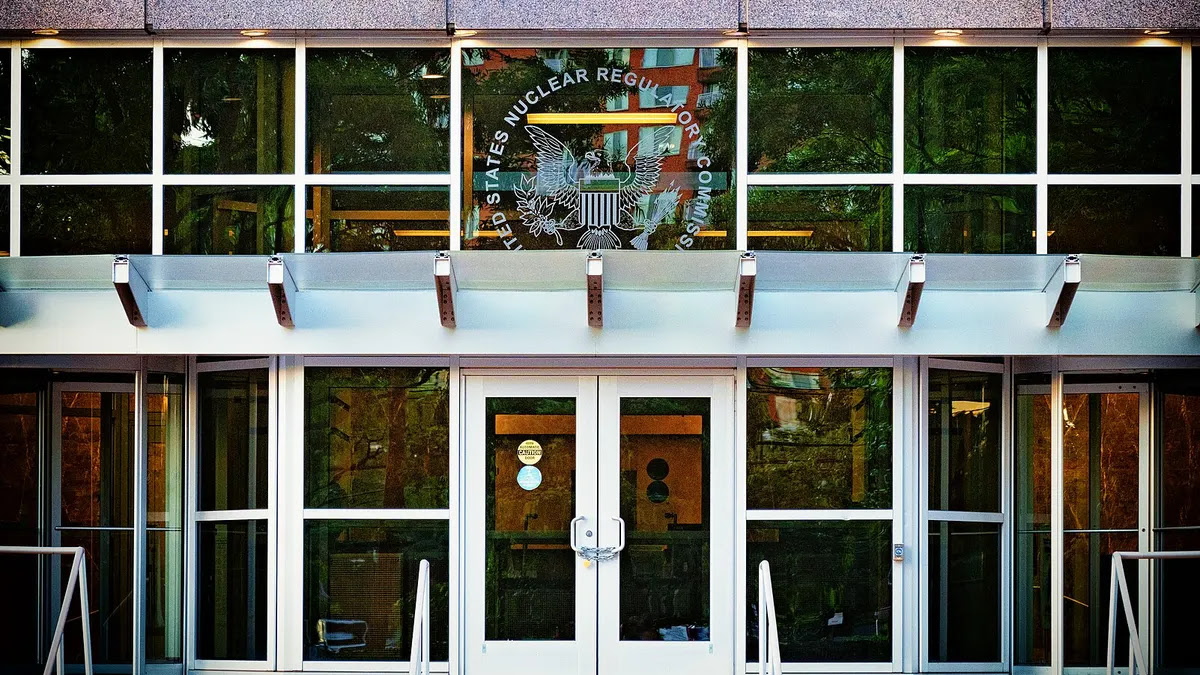
President Trump fired Christopher Hanson, a commissioner at the Nuclear Regulatory Commission, on June 13, 2025. The image by Tony Webster is licensed under CC BY-SA 2.0
Dive Brief:
Nuclear industry watchdogs and advocates alike worry that President Trump’s abrupt firing of Commissioner Christopher Hanson from the U.S. Nuclear Regulatory Commission will hinder ongoing NRC reforms and threaten Trump’s promise of an American nuclear renaissance.
Hanson’s dismissal opens a vacancy on the five-member Commission, which requires three members to meet quorum. A second vacancy looms if the U.S. Senate fails to act on Trump’s renomination of Chairman David Wright by July 1.
In a public statement, Hanson described his termination late on June 13 as “without cause, contrary to existing law and longstanding precedent regarding removal of independent agency appointees.”
Hanson has not yet taken legal action to challenge his dismissal or indicated whether he plans to do so. The U.S. Supreme Court in a May ruling gave the President broad latitude to dismiss most independent agency appointees without cause.
A White House spokesperson told National Public Radio that Trump “reserves the right to remove employees within his own executive branch who exert his executive authority” and that “[a]ll organizations are more effective when leaders are rowing in the same direction.” The spokesperson did not indicate what prompted Hanson’s dismissal.
Industry groups and pro-nuclear nongovernmental organizations voiced concern that the firing would set NRC back just as its workload balloons.
A Breakthrough Institute analysis of NRC voting records shows that a fully staffed Commission is nearly twice as efficient as a three-member Commission, said Adam Stein, director for nuclear innovation at the pro-nuclear think tank.
“While a three-member commission would “[satisfy] the quorum requirement, past experience has shown that a full five-member Commission is essential for effective and timely decision making,” Stein said in a June 16 statement.
Other pro-nuclear groups echoed Stein’s efficiency concerns and hinted that Hanson’s firing could erode NRC’s legal authority.
“The arbitrary removal of commissioners without due cause creates regulatory uncertainty that threatens to delay America’s nuclear energy expansion,” the American Nuclear Society said on Monday.
Public trust could also suffer, as could the U.S.’s aspirations to be a major Western exporter of advanced nuclear technology, Nuclear Innovation Alliance President and CEO Judi Greenwald said.
“As advocates for new nuclear energy, we are focused on the NRC’s role in reestablishing U.S. nuclear energy leadership,” Greenwald said in a Monday statement. “Undermining NRC’s independence is damaging to both long-term U.S. interests and to the ongoing work that is required to ensure that nuclear power can provide reliable and clean energy to power the American economy.”
Greenwald’s June 16 comments echo an NIA statement last month which offered qualified praise for Trump’s executive orders while warning against staff and funding cuts at the agencies responsible for implementing them, including NRC.
“Our assessment is that NRC is already making significant progress on reform in compliance with congressional direction including the 2024 ADVANCE Act,” she said on May 23. “It is in everyone’s interest that this progress continue and not be undermined by staffing cuts or upended by conflicting directives.”
Longtime industry watchdog Edwin Lyman, director of nuclear power safety for the Union of Concerned Scientists, said Trump’s move would undercut NRC’s core safety mission.
“The main issue is that [NRC] was created specifically to avoid conflicts of interest associated with being directed by the executive branch,” Lyman said in an interview. “That independence is critical because it shows that they are making judgments based on safety criteria and not … favoring one technology or applicant over another for political reasons.”
Efforts to streamline NRC operations began in earnest with the enactment last year of the ADVANCE Act, which directed the agency to set deadlines for reactor licensing reviews, expedite certain applications and develop guidelines for lower-output microreactors.
That push has accelerated under Trump, propelled by what Lyman said are unvetted industry claims that advanced nuclear plants are inherently safer than conventional power reactors. That means it’s exactly the wrong time to weaken NRC independence, he said.
“The industry has had a chip on its shoulder for so long that it’s afraid to be honest about what it doesn’t know, and it’s putting forth a positive message that’s not backed by science,” Lyman said. “It’s the regulator’s role to see through that.
The Nuclear Regulatory Commission has decided on three policy matters to enable new ways of deploying microreactors. These very small reactors could be built, loaded with fuel, and tested at factories before being shipped to operating sites, and would generate about one percent or less of the power of a current large reactor.
The Commission’s first decision is that a factory-fabricated microreactor loaded with fuel may be excluded from being “in operation” if it has features to prevent a nuclear chain reaction. The second decision is that a microreactor with features to prevent a chain reaction may be loaded with fuel at a factory if it is done under an NRC license that allows possession of the fuel. The third decision is that the NRC staff may apply regulations for nonpower reactors to authorize testing of a microreactor at a factory before it is shipped to an operating site.
The Commission also directed the staff to continue other microreactor-related activities, such as engaging with Department of Energy/Defense efforts to build and operate microreactors on DOE/DOD sites or as part of critical national security infrastructure. This engagement aims to identify and implement licensing process efficiencies, consistent with the ADVANCE Act and relevant executive orders, to streamline the transition of microreactor technology to the commercial sector.
President Donald Trump has terminated Commissioner Christopher Hanson from the Nuclear Regulatory Commission, the latest move by the White House to assert control over independent agencies.
Hanson said in a statement Monday that he was removed from the position Friday “without cause” and “contrary to existing law and longstanding precedent regarding removal of independent agency appointees.”
HARRISBURG, Pa. (AP) — Amazon said Monday that it will spend $20 billion on two data center complexes in Pennsylvania, including one it is building alongside a nuclear power plant that has drawn federal scrutiny over an arrangement to essentially plug right into the power plant.
NEED TO KNOW: A group of bills aimed at boosting electricity production and regulating clean energy has rare, bipartisan support in Pennsylvania’s divided legislature. But a key GOP leader says he doesn’t plan to consider them until a court issues a final verdict on the long-debated Regional Greenhouse Gas Initiative, or RGGI. Read more in Spotlight PA’s full report →
GOOD TO KNOW: States that are a part of RGGI agree to cap the amount of carbon that emitters within their borders can release, lowering the cap over time. These emitters, typically energy companies, must buy credits from the state to emit any carbon, the proceeds from which go to the state. The previous Democratic administration joined the program via executive order in 2019 in an effort to combat climate change. It has been mired in litigation since.
IN THE KNOW: The state’s highest court is preparing its ruling on RGGI’s fate after hearing arguments in May. State Senate Majority Leader Joe Pittman (R., Indiana) told Spotlight PA that until a decision is made, his chamber is unlikely to act on energy bills. Continue reading to find out why
HARRISBURG — A group of bills aimed at boosting electricity production and regulating clean energy has rare, bipartisan support in Pennsylvania's divided legislature.
But a key Republican leader says he doesn’t plan to consider them until a court issues a final verdict on a long-debated interstate cap-and-trade program.
That program is the Regional Greenhouse Gas Initiative, or RGGI, which the previous Democratic administration joined via executive order in 2019 in an effort to combat climate change. It has been mired in litigation since.
The state's highest court is preparing its ruling on the program's fate after hearing arguments in May. State Senate Majority Leader Joe Pittman (R., Indiana) told Spotlight PA that until a decision is made, his chamber is unlikely to act on energy bills.
The Senate, Pittman said, is “very limited” in its ability to pass energy-related legislation because the RGGI ruling will “dictate the course of energy production” in the state.
“For us to look at other proposals that the governor has [isn’t] very productive,” Pittman said. “You could say all you want about this EDGE tax credit. If RGGI goes in, those tax credits won't mean a darn thing.”
States that are a part of RGGI agree to cap the amount of carbon that emitters within their borders can release, lowering the cap over time. These emitters, typically energy companies, must buy credits from the state to emit any carbon, the proceeds from which go to the state.
Supporters say that the carbon cap will drastically reduce the amount of harmful greenhouse gases emitted in the state while having minimal effects on energy costs. Opponents argue it will drive energy companies away from Pennsylvania and discourage them from building power plants, leading to higher costs for consumers.
EDGE, or Economic Development for a Growing Economy, is a $2.6 billion package of tax credits that lawmakers passed in 2022 that has never been used. Democratic Gov. Josh Shapiro has proposed rewriting the package to make it easier for companies to take advantage, and the effort has bipartisan support, including in Pittman’s chamber.
The original credit would have benefited hydrogen fuel producers, dairy farmers, semiconductor manufacturers, and petrochemical producers that use natural gas.
One rewrite of the package already passed the Democratic-controlled state House with support from a handful of Republican members.
The measure mirrors Shapiro’s proposal, lowering the minimum investment threshold and the number of jobs a business must create to qualify for the incentive. It would also replace the credit for natural-gas-powered petrochemical producers with one that benefits clean energy producers.
Republicans in the state Senate have made it clear that they, too, want the tax credits to be usable.
It could be a way to “encourage [energy] generators to come to Pennsylvania,” state Sen. Gene Yaw (R., Lycoming), chair of his chamber’s critical Environmental Resources and Energy Committee, told Spotlight PA.
Different visions for the rewrite have sprung up in the state Senate. A bipartisan duo in the upper chamber proposed a bill narrowly focused on helping semiconductor manufacturers claim their credit more easily. Another Democrat and Republican pair pitched amending the credit to benefit companies that develop space-related infrastructure.
Organized labor is on board. Rob Bair, chair of the Pennsylvania Building and Construction Trades Association, a group that represents tens of thousands of union workers, pointed to the new clean energy production provision that Shapiro proposed as a way to drive investment.
“We have the opportunity to rewrite it and use it in conjunction with the IRA now,” Bair said, referring to the federal Inflation Reduction Act, which rewards states with significant federal dollars for clean energy projects. “It still gives us a good pathway to move forward in Pennsylvania.”
Pittman said he hasn’t ruled out considering the state House’s EDGE bill, telling Spotlight PA, “At the end of the day, I'm very deferential to the chairs of our respective committees. So I would need to hear a little more from them, if there's value in what the House passed.”
There are other energy bills that he is more enthusiastic about. All are longtime GOP priorities that Democrats have so far balked at, including measures to pull the state out of RGGI, create an independent office to conduct energy research, and prevent municipalities from banning specific fuel sources, like natural gas.
“Those are all issues we're more than happy to engage in and see go across the finish line,” Pittman said.
The EDGE bill isn’t the only energy measure that has some bipartisan support.
A proposal to allow communities to lease solar panels passed the state House with votes from both major parties. Another measure, sponsored by Yaw, aims to tighten oversight of Pennsylvania’s growing solar energy industry and passed with widespread support in the state Senate.
Lawmakers are also considering whether to renew a popular program, first passed last year, that provides grants to schools for installing solar infrastructure.
Pittman said he has no plans to move those — at least, not “in the period of weeks we're going to be dealing with the budget.” Lawmakers are supposed to complete that work by June 30.
At least one Democratic lawmaker is more optimistic.
State Rep. Liz Fiedler (D., Philadelphia), the chair of her chamber’s Energy Committee, says that talks are still ongoing, and it’s “very likely” that EDGE and the solar bills will be “looped into budget negotiations.”
In early June, she says, everything is still on the table, especially on policy that has strong bipartisan support.
“I think a lot of it is making sure we keep the door open for communication,” Fiedler told Spotlight PA. “Our Republican counterparts in the Senate have expressed openness … but we all hold our breath a little bit [in June].”
As South Floridians—whether we like it or not—our daily existence is tied to the Turkey Point Nuclear Power Plant.
Every time we turn on a light in our homes, every time we take a drink of water, we’re connected. If Turkey Point is not safe and resilient for the future, then neither are we.
Miami Waterkeeper has been challenging Florida Power and Light’s license extension—which would keep it operational into the 2050s, in an area projected to be underwater in the 2040s—and we're educating the community about the threats it poses to our region and our drinking water. So this month, we're using our newsletter to shine a spotlight on Turkey Point and what it means for our future.
We’re now the only plaintiff challenging Turkey Point’s license extension, and we need your help. If you would like to support this critical work, consider joining our monthly giving program and becoming an A.N.C.H.O.R. for Miami’s waters!
We’re getting the word out about the threats posed by Turkey Point’s aging nuclear reactors. Already our two-part animation series—produced with LECHE Studios—has racked up thousands of views! The videos reveal how chloride contamination from Florida Power & Light’s (FPL’s) nuclear power plant is endangering the Biscayne Aquifer—the primary source of drinking water for millions of South Florida residents—and the critical climate risks facing the reactors from sea level rise, storms, and flooding. This series explains why we're challenging this decision and fighting to protect South Florida’s waters.
DON’T TRASH OUR TREASURE: TURKEY POINT EDITION
WPLG Local 10’s Louis Aguirre joined us to learn more about this important topic. Last month, he decided that this story was so important, so big, that it needed two parts. The first focused on FPL’s push to extend the plant’s operating license in the face of growing climate risks, and the second focused on the hypersaline plume of chloride contaminated water which has been spreading from the plant. We applaud Aguirre’s thorough and hard-hitting investigation on this critical issue. Watch part one here and part two here.
BEHIND THE SCENES
Dr. Rachel Silverstein joined Louis Aguirre on Biscayne Bay, right in the shadow of the Turkey Point nuclear plant. Over on our Instagram page, you can go behind the scenes of Local 10’s shoot, as Silverstein and Aguirre discuss what Turkey Point’s license extension could mean for South Floridians.
COMMUNITY SPOTLIGHT
RESTORING CORALS WITH PARTNERSHIP & RESCUE A REEF
Members of our PartnerSHIP Crew joined us for a coral restoration excursion, hosted by Rescue A Reef. Both snorkelers and divers worked to help mitigate the damage from the 2013-2015 PortMiami dredging project. Interested in joining us on the next excursion? Learn more about our PartnerSHIP Program on our website or by contacting christopher@miamiwaterkeeper.org.
CALLING ALL FUTURE ENVIRONMENTAL LEADERS
Applications are now open for the 2025–2026 Junior Ambassador Program—a free, year-long leadership opportunity for high school students in Miami-Dade and Broward Counties.
This unique experience empowers students in grades 9–12 to take action on clean water, climate, and community resilience through hands-on projects, advocacy training, and service events. Participants earn 20+ service hours, build real-world skills, and connect with local experts—all while making a real impact.
Know a student ready to lead the change? Encourage them to apply by June 30!
WHY LET THE HIGH SCHOOLERS HAVE ALL THE FUN?
Become an (adult) Ambassador. Applications are open for our 2025–2026 Ambassador Program—a free, year-long opportunity for adults in South Florida to take action for clean water and a healthier environment.
From field trips and workshops to hands-on service and advocacy training, Ambassadors can make a lasting impact in their communities. No prior experience needed. Apply by June 30.
UPCOMING EVENTS - JOIN US!
Become friends with Miami Waterkeeper! Connect with nature, meet new folks, and get your hands dirty while helping to restore our fragile ecosystem throughout Miami!Click below to RSVP. Event confirmation and details will be emailed to you.
Ongoing donations make a big impact over time—and provide the reliability needed to protect South Florida’s waters for generations to come.
SUPPORT OUR MISSION
Give with confidence knowing that Miami Waterkeeper has our Platinum Badge through GuideStar, a 4-Star Charity rating by Charity Navigator, and a Top Nonprofit ranking on Great Nonprofits.
Parter with us by investing in our mission and making a donation now.
We'd like to thank the following supporters for joining and renewing their support for our 2025 PartnerSHIP Crew in the month of May. You put the wind in our sails.
Members of the PartnerSHIP crew enable Miami Waterkeeper to address crises and tackle long-term, critical policy issues by providing unrestricted funding. For information on joining our PartnerSHIP Crew, and to see the full list partners, click here or contact christopher@miamiwaterkeeper.org.