Docketed this morning - zip of three
| Document Title: | Three Mile Island, Unit 2 Historic and Cultural License Amendment 68 |
| Document Type: | |
| Document Date: |
| Document Title: | Three Mile Island, Unit 2 Historic and Cultural License Amendment 68 |
| Document Type: | |
| Document Date: |
| Document Title: | 20240905 NRC Staff Review of Proposed Changes in NEI 03-12, Revision 8, Security Plan Template No Notes Meeting Slides |
| Document Type: | Meeting Briefing Package/Handouts Slides and Viewgraphs |
| Document Date: | 09/05/2024 |
| 09/05/24 9:00AM - 11:00AM ET | Meeting info The purpose of this meeting is for the NRC staff to provide initial feedback to the Nuclear Energy Institute (NEI) regarding proposed changes in Revision 8 to NEI 03-12, Security Plan Template. [more...] Participation: Partially Closed Teleconference | Teleconference | Jesse Rollins (817) 200-1431 Justin Vazquez (301) 415-0530 |
| Document Title: | 09/11/2024 Alternative Physical Security Requirements for Advanced Reactors Rulemaking: Public Comment Period |
| Document Type: | Meeting Notice Meeting Agenda |
| Document Date: | 08/27/2024 |
| 09/11/24 1:00PM - 4:00PM ET | Meeting info The purpose of this meeting is to present the published proposed rule alternative physical security requirements for advanced reactors (non-light water reactors and small modular reactors). This meeting will also allow an opportunity for stakeholders to ask clarification questions to help understand the proposed rule and to develop any public comments. [more...] Participation: Information with Q&A Teleconference | Webinar | Dennis Andrukat (301) 415-3561 |
https://finance.yahoo.com/news
Utility Dive· FernandoAH via Getty Images
Raya Salter4 min read
This story was originally published on Utility Dive. To receive daily news and insights, subscribe to our free daily Utility Dive newsletter.
Raya Salter is the founder of the Energy Justice Law and Policy Center and a member of the New York State Climate Action Council and the New York Public Service Commission Energy Policy Planning Advisory Council.
Last month, a troubling report penned by the New York State Energy Research and Development Authority acknowledged that New York is not on track to meet the ambitious greenhouse gas emissions reduction targets in our 2019 Climate Act. If this were not bad enough, influential decision-makers and industry players have been calling for New York to weaken it. They want to expand allowable generation sources beyond renewables, and entertain “low-carbon and carbon-free alternatives,” including nuclear power. On September 4-5, the governor’s administration is hosting a Future Energy and Economy Summit at which two of the five panels featured will be speaking about the future of nuclear energy in New York.
We need to be clear: nuclear power is neither a climate solution nor a clean energy solution. It is an expensive, toxic, and dangerous distraction that will only impede New York's progress toward its climate goals. New York needs look no further than the Vogtle reactors in Georgia or the canceled NuScale reactors in Utah. The Vogtle project took 16 years to complete its first reactor and cost more than twice its initial estimate. Costs for the NuScale project doubled before construction even began; eight years after it was first proposed, the project had neither broken ground nor received a single permit.
Of course, New York has its own nuclear cautionary tale: the Shoreham Nuclear Power Plant on Long Island. Promised as a pathway to energy independence in the ‘70s and ‘80s, Shoreham became a financial disaster. The project's cost soared from an initial $75 million estimate to over $6 billion. Due to local opposition, regulatory challenges and safety concerns, the plant was decommissioned before it could provide any commercial power. Long Island ratepayers are still paying Shoreham’s debt. Shoreham’s story is a stark reminder that nuclear projects often come with insurmountable economic and social costs.
Our Climate Act was hard won and a highly supported piece of legislation that led the nation on climate and environmental justice. Our agencies and regulators must follow, and not erode, its protections for frontline communities. Nuclear does the opposite. New York’s existing reactors, their radioactive waste and waste spills, continue to pose a threat to communities who live where nuclear operations, dumping and transport occur. There is no permanent solution to waste that will remain radioactive for thousands of years. Peer-reviewed studies examining these impacts on surrounding communities have identified a number of grave environmental harms and public health risks. Many of these risks disproportionately impact Indigenous communities and other communities of color in the U.S. and worldwide.
Proponents of “advanced” nuclear technologies argue that they offer something new. However, these technologies, including small modular reactors, are based on old concepts that previously failed due to safety, waste management and economic challenges. Claims that these reactors will provide cheaper, safer and faster nuclear energy remain unproven, echoing the same empty promises that led to past failures.
Including nuclear power in New York’s transmission policy planning would also be misguided. Nuclear energy does not align with the goals of a flexible, renewable-driven grid. Relying on nuclear would distract from building infrastructure to support truly renewable sources like wind and solar, which are becoming increasingly cost-effective and reliable. Nuclear power would lock us into a centralized, high-risk generation model that doesn't fit the decentralized nature of modern clean energy systems.
There is a lot of promise for our climate goals despite the gloomy projection. Our state is leading the way in piloting new, clean, efficient and at-scale heating and cooling technologies like utility thermal energy networks. More New Yorkers than ever are interested in and learning about green technologies and the jobs that come with them. We don’t need scenario planning that promises nuclear power on a mythical timeline towards a slower, less ambitious goal. What we need is for New York to meet its climate challenges with urgency and, acting in the public interest, reject false solutions like nuclear power.
Nuclear Regulatory Commission - News Release
No: 24-067 August 28, 2024
CONTACT: Scott Burnell, 301-415-8200

By Mose Buchele KUT 90.5 Updated
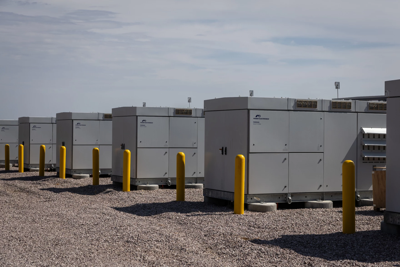
Batteries that store solar energy have boosted the Texas power grid this summer.
Michael Minasi/KUT News
With temperatures climbing over 100 in much of the state, the Texas electric grid set an all-time record for energy demand Tuesday.
Despite the heat wave, the Electric Reliability Council of Texas has yet to ask people to conserve electricity. That’s a big change from 2023, when extreme weather and fear of low power reserves prompted ERCOT to issue 11 requests for conservation through the year.
Grid operators and energy experts are pointing to the rapid growth of solar power and grid-scale batteries as key reasons why residents haven’t been asked to conserve this month.
“We’ve seen significant additions of energy storage resources, solar resources and wind resources, with a few additions also on the gas side,” Pablo Vegas, CEO of the Electric Reliability Council of Texas, said at an ERCOT board meeting Tuesday. “All of that has helped to contribute to less scarcity conditions.”
In fact, the growth of some of those energy sources has been downright record-breaking.
As the sun and heat bore down, Sunday, Monday and Tuesday brought the top three days for solar power production in the history of the state grid, according to the website Gridstatus.io, which tracks the performance of regional electricity transmission systems.
On Sunday, the top day for solar production, Texas solar farms produced 20,832 megawatts of power. It’s worth noting that this number does not include energy produced by rooftop panels on homes and businesses.
According to ERCOT, 1 megawatt is enough to power about 250 homes at times of peak demand.
Texas also set new records Monday and Tuesday for the amount of power provided by big utility-scale batteries, something that could have made the difference between a normal day and a grid emergency.
“The previous storage record was shattered by 25%,” Doug Lewin, author of The Texas Energy and Power Newsletter, tweeted. We “almost certainly would have been rolling outages without it.”
The reason for the rapid uptick in solar and battery power on the state grid is pretty simple.
Energy demand has grown rapidly in Texas over the last few years, and frequent moments of energy scarcity have presented a business opportunity for solar farms and battery storage facilities that can quickly set up shop to fill the need.
Hot, sunny days — the very conditions that bring higher energy use — are also the conditions that produce solar power. That solar energy also can be used to fill large batteries that discharge power back to the grid when the sun sets over solar farms, but air conditioners are still running full blast.
At Tuesday’s meeting, Vegas pointed to other factors that have worked in the grid’s favor recently. Strong winds in the evening have brought wind power online as the sun goes down, and natural gas power plants have not suffered major breakdowns that could throw the grid into scarcity conditions.